Black
Engineering & Computing
Fivefold Pentagons
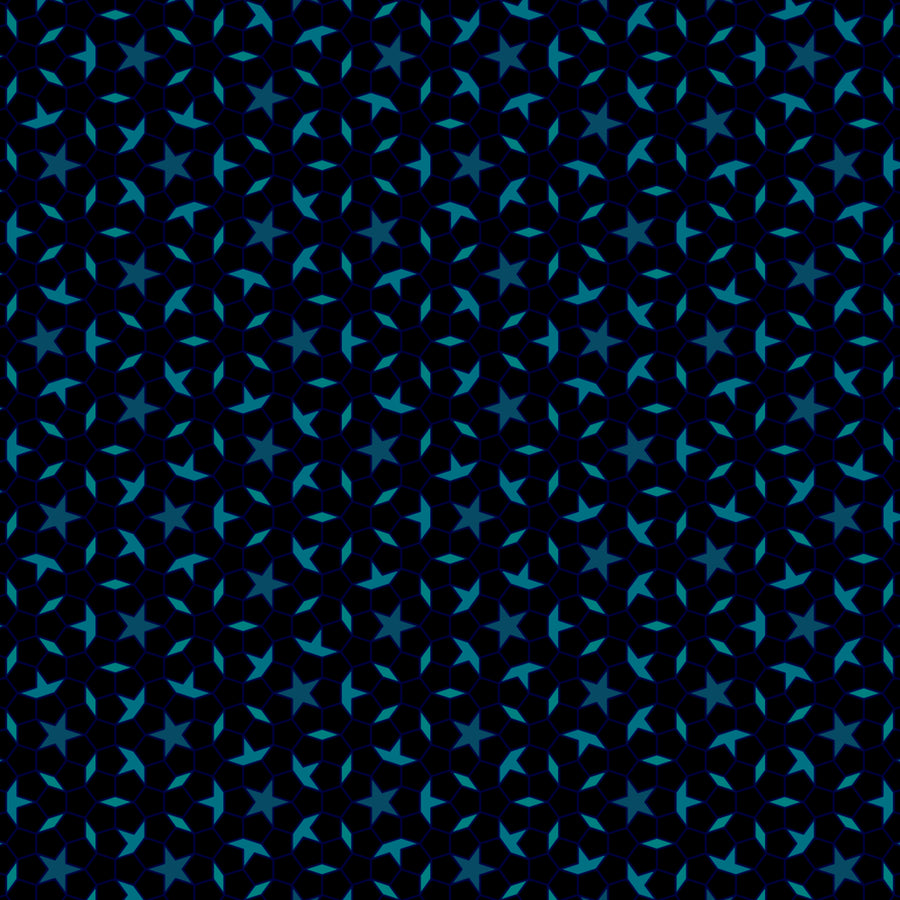
Penrose’s first tiling: pentagons, stars and diamonds.
A never-repeating pattern: This pattern never settles into a repeating rhythm. Part of Fivefold, our family of never-repeating patterns built on the number five.
Five pentagons fit around a sixth, with a gap. In 1974, Roger Penrose showed that if you fill those gaps with three more shapes, a five-pointed star, a ‘boat’ that is three-fifths of a star, and a thin diamond, the result covers the plane forever without repeating.
The process to generate a tiling is recursive: Split every pentagon into six smaller ones, fill the gaps by the same rule, and the whole tiling can rebuild itself one size smaller.
Never-repeating tilings are important puzzles in computation, too: no computer program can always tell whether a given set of tiles will cover an endless floor; a geometric version of the halting problem.
Even simple rules can result in extraordinary complexity: Some tiles can fit together to cover a floor forever, but only if the pattern never repeats. This pattern is one beautiful example.
 Zenzicube