Oxblood & Ivory
Engineering & Computing
Prime Sieve
Write the numbers in rows, and the primes fall into place.
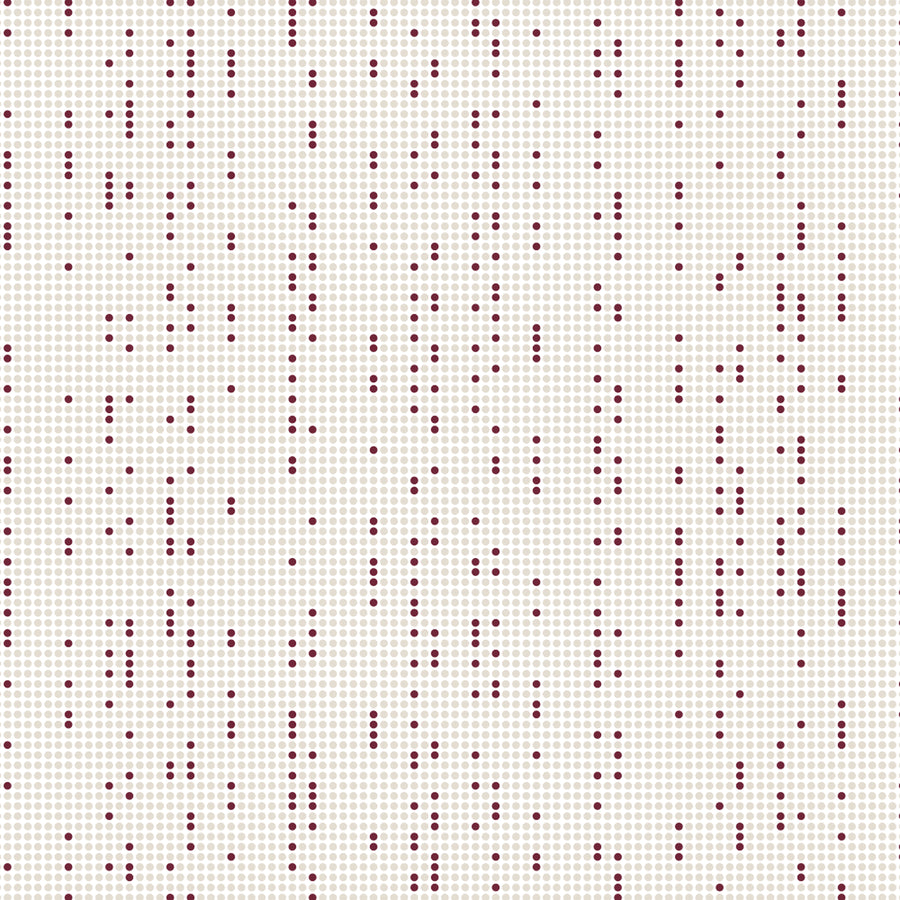
More than two thousand years ago, Eratosthenes of Cyrene found the primes by crossing numbers out using a simple process: Remove every multiple of 2, then of 3, then of 5, and so on. Whatever survives can be divided only by itself and one. In this print every number is a dot: the pale ones crossed out, and the colored ones are prime.
If you write the numbers in rows, the width of the row decides the picture.
Composite Numbers. Rows 750 numbers wide. 750 is 2 × 3 × 5 × 5 × 5, so every multiple of 2, 3 and 5 falls into the same columns row after row. The primes can only live in the columns left over, and they gather into fine vertical stripes.
ForGrown from real mathematics
 Zenzicube
 Zenzicube