Oxblood & Ivory
Engineering & Computing
Prime Sieve
Write the numbers in rows, and the primes fall into place.
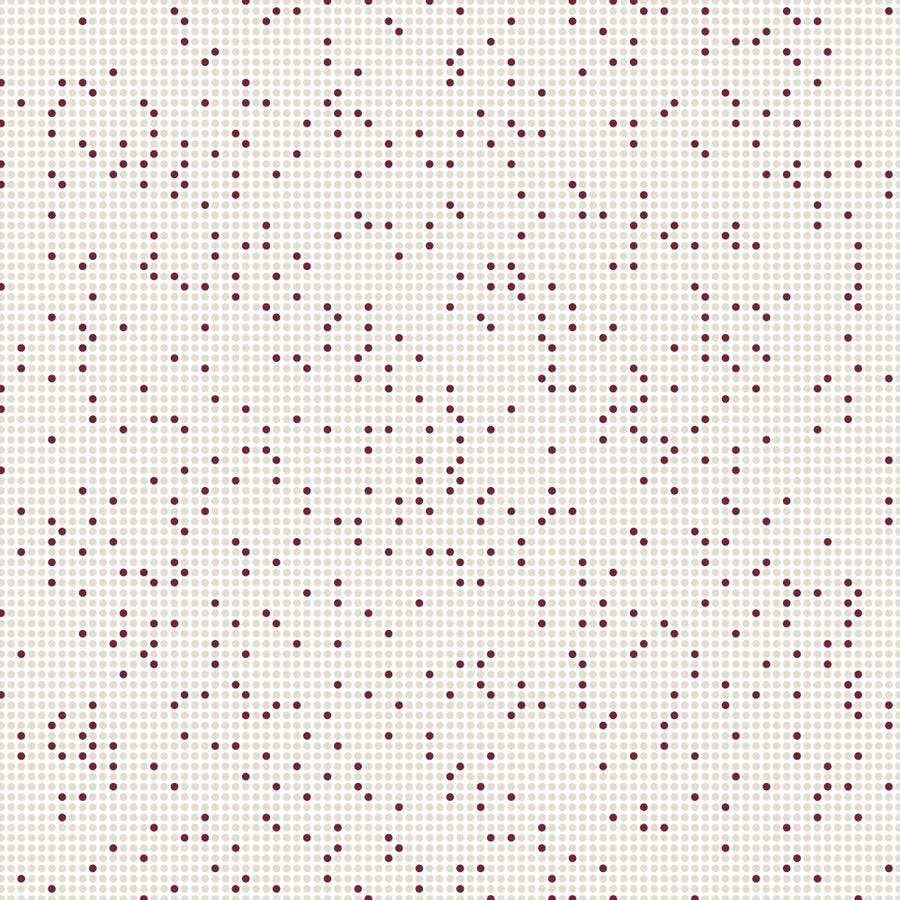
More than two thousand years ago, Eratosthenes of Cyrene found the primes by crossing numbers out using a simple process: Remove every multiple of 2, then of 3, then of 5, and so on. Whatever survives can be divided only by itself and one. In this print every number is a dot: the pale ones crossed out, and the colored ones are prime.
If you write the numbers in rows, the width of the row decides the picture.
Small Remainders. Rows 747 numbers wide. Divide 747 by 2, 3 and 5 and the remainders are 1, 0 and 2. Each small remainder sets the slant for its own multiples: those of 3 stand upright, while those of 2 and 5 drift at different angles, and the primes weave between them. As a result the primes look far less orderly than in the stripes of Composite Numbers, even though they are the same primes.
 Zenzicube